Cagrilintide Mechanism: Amylin Receptor Agonism via AMY1 and AMY3 Receptors
Cagrilintide is a long-acting acylated analogue of human amylin (islet amyloid polypeptide, IAPP), engineered for once-weekly subcutaneous administration. Its mechanism of action is fundamentally distinct from semaglutide, operating through the amylin receptor family — hetero-oligomeric complexes comprising a calcitonin receptor (CTR) subunit associated with one of three receptor activity-modifying proteins (RAMPs 1, 2, or 3). The AMY1 receptor (CTR + RAMP1) and AMY3 receptor (CTR + RAMP3) are the primary targets through which amylin and its analogues exert satiety and metabolic effects.
Native human amylin is co-secreted with insulin from pancreatic beta cells in a roughly equimolar ratio in response to nutrient ingestion. Unlike insulin, amylin acts primarily in the central nervous system to suppress appetite and regulate postprandial glucagon secretion. The primary CNS locus of amylin action is the area postrema — a circumventricular organ lacking a complete blood-brain barrier — where AMY1 and AMY3 receptors are expressed at high density. From the area postrema, amylin signals propagate to the nucleus tractus solitarius (NTS) and onward to hypothalamic nuclei, engaging appetite-suppressing circuits that are entirely separate from those activated by GLP-1R agonism.
Cagrilintide's structural modifications relative to native amylin include an alanine-to-serine substitution at position 25 (preventing amyloid fibril formation, the property responsible for amylin's toxicity in islet tissue in type 2 diabetes) and a C20 fatty diacid chain attached via a hydrophilic linker to lysine at position 1. This acylation strategy mirrors semaglutide's C18 modification and similarly confers albumin binding-mediated extended half-life, enabling once-weekly dosing. The resulting PK profile — Tmax of 2–3 days, estimated half-life of 7 days in humans — is closely matched to semaglutide, making fixed-ratio co-formulation in CagriSema feasible from a pharmaceutical engineering standpoint.
COMBINE 2 Trial: CagriSema Efficacy Versus Semaglutide Monotherapy
The COMBINE 2 trial (NCT04982575) is the pivotal Phase 2 randomized controlled trial that established the efficacy advantage of the CagriSema fixed-ratio combination over semaglutide monotherapy at matched doses. Enrolled participants were adults with obesity (BMI ≥30) or overweight (BMI ≥27) with at least one weight-related comorbidity but without type 2 diabetes, receiving treatment over 32 weeks.
The primary endpoint — percentage change in body weight from baseline to week 32 — demonstrated that CagriSema (cagrilintide 2.4 mg + semaglutide 2.4 mg) achieved a mean weight reduction of -22.7%, compared to -16.1% for semaglutide 2.4 mg monotherapy and -8.0% for cagrilintide 2.4 mg monotherapy. This 6.6 percentage point advantage of the combination over semaglutide alone represents a clinically meaningful differentiation and confirms the mechanistic hypothesis that amylin pathway activation provides additive weight-reducing effects beyond maximal GLP-1R stimulation.
Secondary endpoints including waist circumference reduction, systolic blood pressure change, and HbA1c improvement (in participants with prediabetes at baseline) consistently favored the CagriSema combination. The proportion of participants achieving weight loss thresholds was particularly striking: 59% of CagriSema-treated participants achieved ≥20% weight loss at 32 weeks, compared to 22% with semaglutide alone — a nearly three-fold difference at this clinically relevant threshold.
The gastrointestinal adverse event profile of CagriSema was consistent with the additive administration of two gut-active peptides but was generally manageable and did not result in meaningfully higher discontinuation rates versus semaglutide monotherapy. These findings provided the evidentiary basis for advancing CagriSema into the Phase 3 REDEFINE program and for research interest in the 5 mg CagriSema research vial as a tool to investigate the combined dual-pathway mechanism at the preclinical level.
Dual Receptor Pathway: Additive Appetite Suppression Through Independent Neural Circuits
The mechanistic rationale for combining cagrilintide and semaglutide in a fixed-ratio formulation rests on the documented independence of the amylin and GLP-1 appetite suppression circuits in the central nervous system. This independence means that maximal activation of one pathway does not occlude the additive contribution of the other — a pharmacological property that enables supra-additive or at minimum additive efficacy at the combination's ceiling effect.
GLP-1R-mediated appetite suppression is predominantly transmitted through vagal afferents to the NTS and via direct GLP-1R activation in the hypothalamic ARC, PVN, and lateral hypothalamic area. The key downstream mediators include POMC/CART neuron activation, NPY/AgRP neuron suppression, and increased melanocortin 4 receptor (MC4R) signaling in the PVN — a circuit whose maximal activation capacity defines the ceiling of GLP-1R agonist monotherapy efficacy.
Amylin receptor-mediated satiety, by contrast, is initiated primarily in the area postrema, with secondary projections to the NTS but with distinct downstream wiring into the lateral parabrachial nucleus (LPbN) — a key brainstem hub for aversive and satiety signaling — and from there to forebrain circuits including the central amygdala and bed nucleus of the stria terminalis. This routing means that amylin-pathway satiety signals reach hypothalamic integration centers via a brainstem-to-forebrain pathway distinct from the hypothalamus-descending pathway dominant in GLP-1R agonism.
Electrophysiological and optogenetic studies in mice have demonstrated that pharmacological blockade of GLP-1R signaling does not attenuate amylin-receptor-mediated hypophagia, and vice versa — confirming circuit independence. When both pathways are activated simultaneously in rodent models, the recorded reduction in food intake exceeds that achievable by either pathway at maximal activation alone, demonstrating genuine additive and in some experimental paradigms supra-additive appetite suppression. This neural circuit independence is the mechanistic cornerstone that makes the CagriSema research vial conceptually distinct from mono-agonist research tools.
Comparison to Retatrutide: CagriSema Efficacy Without GcgR Axis Engagement
The positioning of CagriSema within the landscape of next-generation weight-loss pharmacotherapy is clarified by comparison to retatrutide — the triple agonist (GLP-1R/GIPR/GcgR) that achieved -24.2% mean body weight reduction at 48 weeks in Phase 2 trials. CagriSema approaches this level of efficacy through a fundamentally different mechanistic architecture, notably without engaging the glucagon receptor (GcgR) axis.
GcgR agonism, the distinguishing feature of retatrutide relative to earlier dual agonists, drives hepatic glucose production suppression, thermogenesis enhancement through brown adipose tissue GcgR activation, and potentially direct CNS appetite effects. However, GcgR agonism also carries a risk of elevating fasting glucose in certain metabolic contexts and requires careful balancing with GLP-1R-mediated insulin secretion amplification to avoid net hyperglycemia — a pharmacological tension that shapes the design of triple agonist dose escalation protocols.
CagriSema achieves comparable efficacy estimates through the addition of amylin pathway engagement rather than glucagon receptor agonism. From a research perspective, this distinction is significant: the amylin receptor and GLP-1R pathways operate through independent central neural circuits (as described above), while GcgR effects are predominantly peripheral (hepatic and adipose) with secondary central effects. Research using CagriSema vials can therefore interrogate the central satiety circuitry without introducing the metabolic complexity of glucagon axis activation, enabling cleaner mechanistic dissection of appetite suppression versus energy expenditure contributions to weight loss.
Phase 2 efficacy projections suggest that CagriSema at optimized doses may achieve 25–30% weight loss in Phase 3 trials when administered over longer durations (52+ weeks), which would approach retatrutide efficacy. Whether the ceiling effects of the two combinations differ — reflecting the different biological ceilings of amylin vs. GcgR-mediated energy expenditure enhancement — is a central question the REDEFINE Phase 3 program is designed to answer.
CagriSema Phase 3 REDEFINE Program: Trial Design and Interim Considerations
The REDEFINE Phase 3 clinical program represents the pivotal regulatory development pathway for the fixed-ratio CagriSema combination (cagrilintide 2.4 mg + semaglutide 2.4 mg, once weekly). Multiple REDEFINE trials are designed to assess weight loss efficacy, safety, and cardiovascular outcomes across diverse populations, providing the comprehensive evidence package required for regulatory approval consideration.
REDEFINE 1 is the core obesity trial, enrolling adults with BMI ≥30 or ≥27 with comorbidities, treated for 68 weeks — matching the STEP 1 timeline to enable cross-trial comparisons. The primary endpoints are percentage change in body weight from baseline and the proportion of participants achieving ≥5% weight loss. Secondary endpoints include cardiometabolic biomarkers, patient-reported outcomes related to physical function and quality of life, and safety assessments encompassing gastrointestinal tolerability, heart rate, and thyroid biomarkers.
REDEFINE 2 addresses the type 2 diabetes population, where the glycemic management dimension adds complexity to the weight loss primary endpoint — mirroring the STEP 2 design but with the expectation that the amylin component's glucagon-suppressive effects will provide incremental glycemic benefit beyond semaglutide alone. Amylin analogues are known to suppress postprandial glucagon secretion through area postrema-mediated inhibition of glucagon-secreting alpha cells, which should complement semaglutide's glucose-dependent insulin secretion amplification.
Interim analyses from early REDEFINE enrollment, while not publicly presented in full detail, have not triggered any safety-related protocol amendments — a reassuring signal consistent with the Phase 2 COMBINE program's manageable safety profile. Long-term cardiovascular outcomes data from REDEFINE will be critical for establishing whether the combination's superior weight loss translates to proportionally superior MACE reduction or whether there is a ceiling to cardiovascular benefit achievable through weight loss-mediated mechanisms alone. These are precisely the mechanistic questions that research using the CagriSema 5 mg vial is positioned to investigate at the preclinical level ahead of Phase 3 data maturation.
Research Protocol Design for Dual-Pathway Studies Using CagriSema Vials
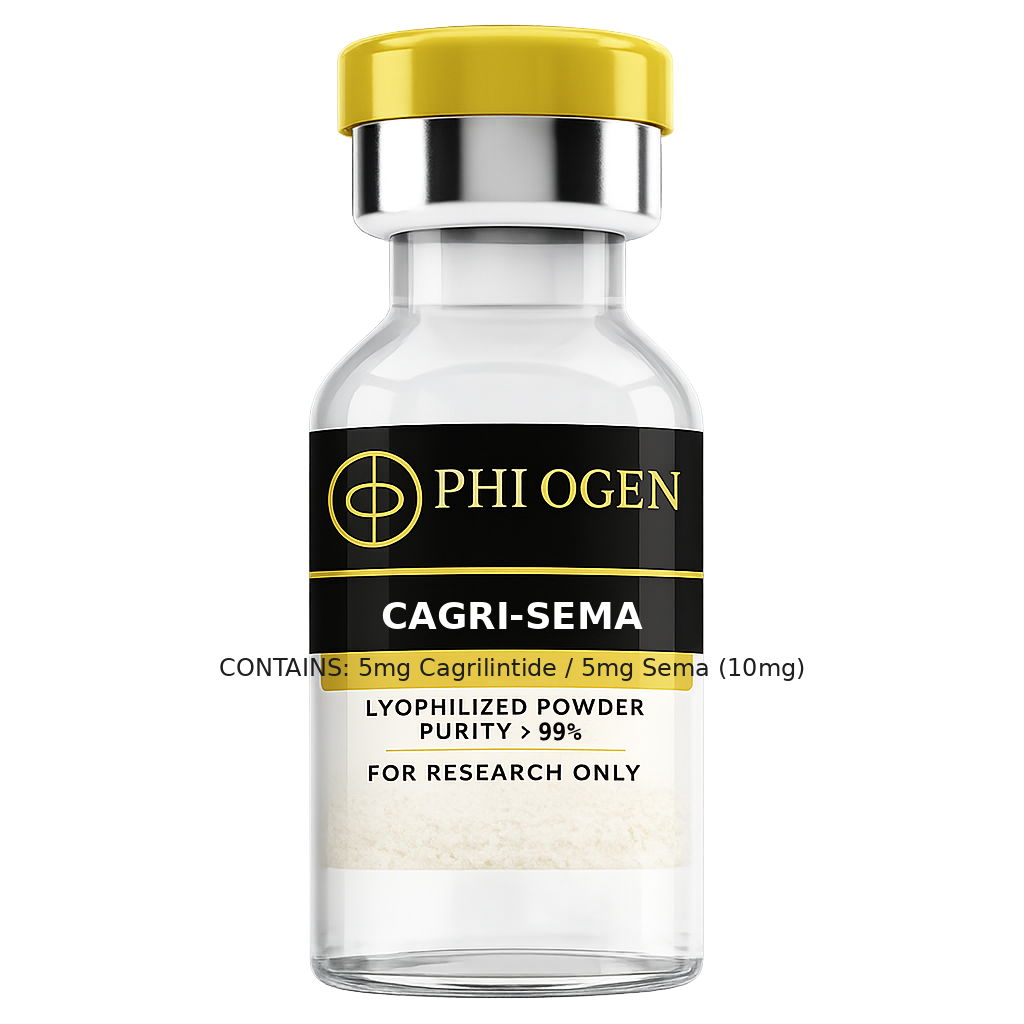
Designing rigorous preclinical research protocols using CagriSema vials requires careful attention to the fixed-ratio nature of the combination and the mechanistic requirements for properly characterizing additive versus independent pathway contributions. The 5 mg CagriSema research vial (containing cagrilintide and semaglutide in equimolar or fixed-ratio formulation) enables head-to-head comparison studies against semaglutide monotherapy and cagrilintide monotherapy using matched concentrations derived from separate vials.
A standard four-arm study design for rodent in vivo CagriSema research includes: (1) vehicle control, (2) semaglutide monotherapy at dose matched to the CagriSema semaglutide component, (3) cagrilintide monotherapy at dose matched to the CagriSema cagrilintide component, and (4) CagriSema combination. Statistical interaction analysis (two-way ANOVA with interaction term) applied to primary endpoints allows quantification of whether the combination effect exceeds the additive prediction from the individual monotherapy arms — formally testing the additivity hypothesis that underlies the mechanistic rationale for the combination.
For central nervous system circuit studies, the CagriSema vial enables ex vivo c-Fos immunohistochemistry experiments assessing neuronal activation patterns in area postrema, NTS, ARC, PVN, and lateral parabrachial nucleus following acute and chronic administration. The expected finding — that CagriSema activates both the amylin-responsive brainstem circuitry and the GLP-1-responsive hypothalamic circuitry simultaneously — can be visualized at the neuroanatomical level and quantified using cell counting algorithms in histological image analysis software.
Microdialysis studies in freely moving rodents enable real-time neurotransmitter sampling from specific brain regions during CagriSema administration, allowing characterization of changes in dopamine, serotonin, and glutamate release in reward and satiety circuits. Combined with behavioral palatability tests (sucrose preference, progressive ratio food motivation), these neurochemical measurements can dissect the relative contributions of hedonic appetite suppression versus homeostatic appetite suppression to the combination's efficacy advantage.
Amylin Receptor Biology: Area Postrema Circuitry and Interaction with Leptin Signaling
The area postrema (AP) is a small unpaired structure located at the caudal tip of the fourth ventricle, characterized by fenestrated capillaries that permit circulating peptides to access AP neurons without crossing a tight blood-brain barrier. This anatomical feature makes the AP the primary interface between peripheral metabolic hormones — including amylin, GLP-1, PYY, and leptin — and the central nervous system satiety circuitry.
Amylin receptor signaling in the AP activates neurons projecting to the NTS, where integration with vagal afferent food intake signals occurs. From the NTS, catecholaminergic projections ascend to the paraventricular nucleus (PVN) of the hypothalamus, where they converge with hypothalamic leptin receptor-expressing neurons. This convergence point is mechanistically significant: amylin sensitizes leptin signaling in the PVN, restoring hypothalamic leptin responsiveness in diet-induced obese rodents that have developed central leptin resistance — a phenomenon termed "amylin-leptin synergy."
The amylin-leptin synergy has been demonstrated in rodent studies where co-administration of amylin (to restore leptin sensitivity) with leptin (to re-engage the leptin-responsive circuit) produces dramatically enhanced weight loss compared to either agent alone in DIO mice that had become unresponsive to leptin monotherapy. Whether CagriSema engagement of the amylin receptor similarly restores hypothalamic leptin sensitivity — potentially enabling more effective long-term weight management in populations with established leptin resistance — is an active research question relevant to the CagriSema 5 mg vial's research applications in obese rodent models with documented leptin resistance.
Calcitonin receptor (CTR) signaling, the core component of amylin receptor heterocomplexes, also mediates bone metabolism and calcium homeostasis effects. Researchers using CagriSema vials in long-duration in vivo protocols should incorporate bone turnover markers (serum CTX-1, P1NP) into the endpoint panel to characterize any CTR-mediated skeletal effects attributable to the cagrilintide component, particularly in studies extending beyond 12 weeks.
Reconstitution and Handling of CagriSema Fixed-Ratio Research Vials
Handling of CagriSema fixed-ratio research vials introduces considerations specific to the co-formulation of two distinct acylated peptides in a single preparation. Both cagrilintide and semaglutide are C18/C20 fatty acid-acylated peptides with albumin-binding properties, and their co-formulation requires a diluent system that maintains solubility and compatibility for both peptide moieties simultaneously.
Reconstitution of CagriSema lyophilized vials should be performed with sterile bacteriostatic water for injection (0.9% benzyl alcohol) added slowly to the vial wall, followed by gentle rolling (not vortexing) to dissolve the lyophilized cake. The dissolved solution should be clear to slightly opalescent with no particulate matter; cloudiness or visible aggregates warrant discarding, as these may indicate peptide co-precipitation arising from incompatible reconstitution conditions. pH sensitivity of the co-formulation is particularly important: the optimal pH range for both components' solubility overlaps in the 7.0–7.5 range, and deviations below pH 6 or above pH 8 risk selective precipitation of one component.
For researchers requiring separate administration of the combination components — for example, to test different dose ratios outside the fixed 1:1 formulation — separate semaglutide and cagrilintide vials should be used, with concurrent administration in separate subcutaneous injection sites or sequentially in a defined protocol. The fixed-ratio CagriSema vial is not appropriate for protocols requiring independent dose variation of each component.
Analytical verification of CagriSema reconstituted solutions by HPLC should resolve two distinct peptide peaks corresponding to cagrilintide (MW ~4647 Da) and semaglutide (MW ~4114 Da), allowing independent purity and concentration assessment for each component. Mass spectrometry confirmation of both peptide masses in a single LC-MS run provides comprehensive identity verification. Certificate of analysis documentation for CagriSema research vials should specify purity and content for each component independently, and researchers should review CoA data carefully to confirm both components meet specification thresholds before initiating experimental work.