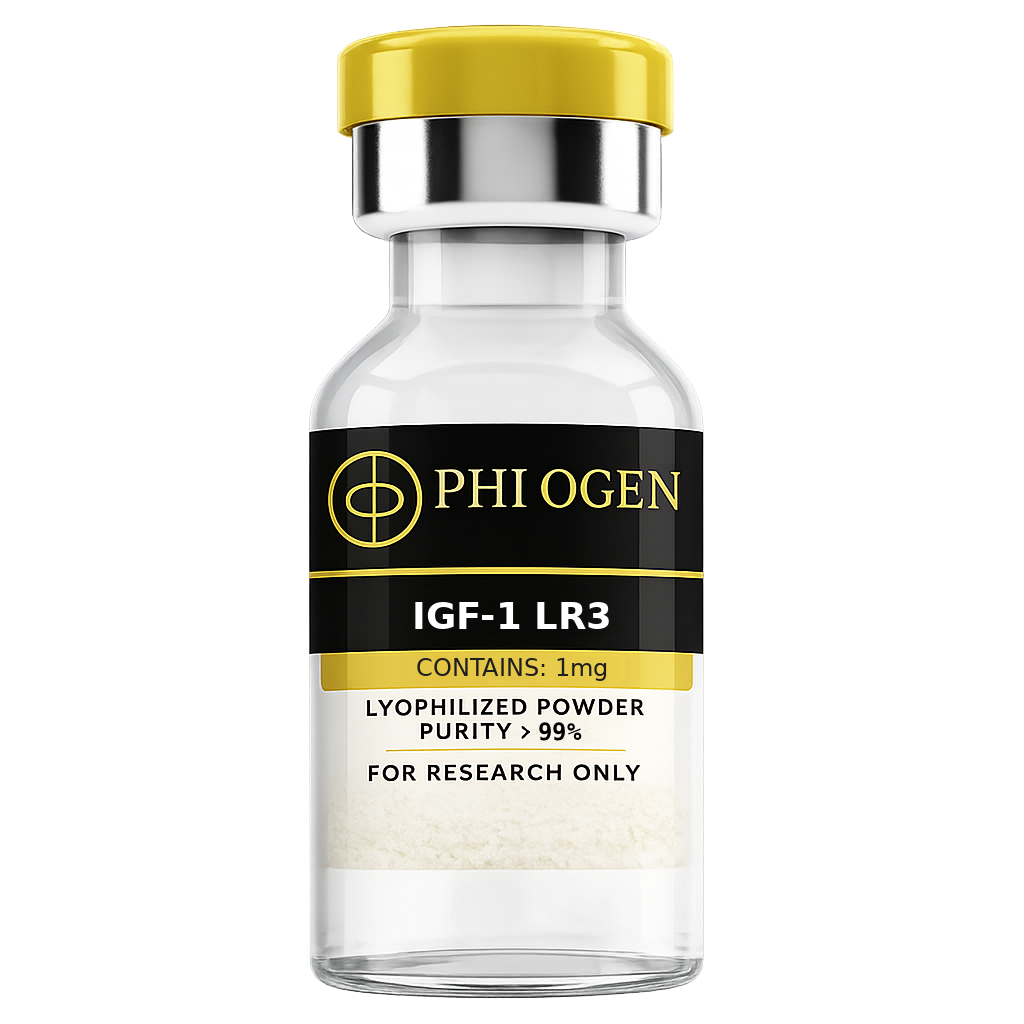
IGF-1 LR3: Structural Modifications and Binding Protein Resistance
IGF-1 LR3 (Long R3 IGF-1) is a recombinant analog of human insulin-like growth factor 1 incorporating two deliberate structural modifications that substantially alter its pharmacokinetic and pharmacodynamic profile relative to native IGF-1. The first modification is a substitution of arginine (Arg) for glutamate (Glu) at position 3 of the mature IGF-1 sequence. The second is an N-terminal extension of 13 amino acids (the "Long" designation, sequence: Met-Lys-Pro-Leu-Cys-Lys-Pro-Gln-Thr-Leu-Pro-Leu-Thr) added upstream of the native sequence.
These modifications were rationally designed to reduce the affinity of IGF-1 for its six high-affinity binding proteins (IGFBP-1 through IGFBP-6). In the circulation, native IGF-1 is largely sequestered by IGFBPs, with only approximately 1% existing as free, receptor-competent peptide at any given time. IGFBP-3, the dominant binding protein, and the acid-labile subunit form a ternary complex that traps the bulk of circulating IGF-1 and prevents receptor access. The IGFBP binding site on native IGF-1 overlaps substantially with regions encompassing the N-terminal helix and the C-domain loop. The Arg3 substitution and the 13-amino acid N-terminal extension sterically obstruct IGFBP engagement while preserving IGF-1R binding affinity, reducing IGFBP affinity by approximately 1000-fold relative to native IGF-1.
The functional consequence is dramatic: while native IGF-1 has a half-life of approximately 12–18 hours when bound in ternary complex (but only minutes when free), IGF-1 LR3 — unable to form ternary complex efficiently — nonetheless achieves a half-life of 20–30 hours in vivo, attributable to its moderate size (approximately 9.1 kDa), reduced renal clearance, and residual weak IGFBP interactions. This combination of IGFBP resistance and extended half-life makes IGF-1 LR3 a powerful research tool for investigating sustained IGF-1 receptor signaling without the interference inherent in studying native IGF-1.
PI3K/AKT/mTOR Pathway: Protein Synthesis Cascade
IGF-1R activation by IGF-1 LR3 initiates intracellular signaling through a well-characterized phosphorylation cascade beginning with autophosphorylation of the receptor's cytoplasmic tyrosine kinase domain at residues Tyr1158, Tyr1162, and Tyr1163. Activated IGF-1R phosphorylates scaffold proteins insulin receptor substrate-1 (IRS-1) and IRS-2 on multiple tyrosine residues, generating docking sites for the p85 regulatory subunit of phosphoinositide 3-kinase (PI3K). PI3K activation generates the second messenger phosphatidylinositol 3,4,5-trisphosphate (PIP3) at the inner leaflet of the plasma membrane.
PIP3 recruits AKT (protein kinase B) and its activating kinase PDK1 to the membrane, where PDK1 phosphorylates AKT at Thr308. Full AKT activation requires additional phosphorylation at Ser473 by mTOR complex 2 (mTORC2). Fully activated AKT phosphorylates and inhibits TSC2 (tuberous sclerosis complex 2), releasing mTOR complex 1 (mTORC1) from TSC-mediated suppression. mTORC1 in turn phosphorylates S6 kinase 1 (S6K1) at Thr389 and 4E-binding protein 1 (4E-BP1) at multiple sites. S6K1 activation promotes ribosome biogenesis and translational elongation. 4E-BP1 phosphorylation releases eukaryotic initiation factor 4E (eIF4E) to form the eIF4F cap-binding complex, enabling cap-dependent mRNA translation initiation.
In skeletal muscle research models, IGF-1 LR3 treatment produces quantifiable increases in 4E-BP1 and S6K1 phosphorylation within 15–30 minutes, which can be followed by measurement of puromycin incorporation (SUnSET method) or [35S]-methionine incorporation to quantify de novo protein synthesis rates. The IGFBP-resistance of LR3 ensures that exogenously added peptide in cell culture media reaches the receptor surface without being sequestered by secreted IGFBPs, providing a cleaner signaling response than native IGF-1 in vitro.
MAPK/ERK Pathway: Cell Proliferation and Myogenesis
Parallel to PI3K/AKT signaling, IGF-1R activation recruits Shc adapter protein and Grb2-SOS to activate the small GTPase RAS. RAS-GTP activates the RAF-MEK-ERK kinase cascade (MAPK pathway), culminating in ERK1/2 phosphorylation and nuclear translocation. ERK1/2-mediated transcription factor activation (ELK1, c-Fos, c-Jun) drives expression of genes regulating cell cycle progression, particularly cyclin D1, which promotes G1/S transition via CDK4/6-mediated Rb phosphorylation.
In myogenesis research, the MAPK pathway downstream of IGF-1R plays a complex role that depends on differentiation stage. In proliferating myoblasts (satellite cells prior to commitment), sustained ERK1/2 activation maintains cells in a proliferative state by suppressing myogenic differentiation factors. As cells transition to differentiation, ERK1/2 activity must decline to permit myogenin and MRF4 expression. IGF-1 LR3 studies in C2C12 myoblasts have demonstrated that its sustained receptor engagement can drive an initial proliferative phase (ERK-dominant) followed, with differentiation-inducing culture conditions, by a PI3K/AKT-dominant anabolic phase. This sequential signaling provides a mechanistic framework for the satellite cell response to IGF-1 in muscle repair contexts.
The ratio of PI3K/AKT to MAPK/ERK signaling downstream of IGF-1R is influenced by the duration and concentration of ligand exposure, the expression levels of downstream effectors, and feedback regulation through IRS-1 serine phosphorylation by S6K1 (a negative feedback loop). IGF-1 LR3's prolonged receptor occupancy compared to native IGF-1 shifts the signaling balance toward sustained anabolic output in differentiated muscle fibers while providing a more complex biphasic response in undifferentiated precursor cells.
Satellite Cell Biology: MyoD, Myogenin, and Muscle Stem Cell Research
Skeletal muscle satellite cells are quiescent tissue-resident stem cells located beneath the basal lamina of individual muscle fibers. They are identified by expression of the transcription factor Pax7 and serve as the primary source of new myonuclei following muscle injury or hypertrophic stimulation. Activation of satellite cells from quiescence involves downregulation of Pax7 and upregulation of MyoD (myoblast determination protein 1), a master regulatory transcription factor of the myogenic lineage. Activated myoblasts can either commit to terminal differentiation (expressing Myogenin, MRF4, and fusing into fibers) or self-renew to replenish the satellite cell pool.
IGF-1 signaling, both systemic and locally produced by contracting muscle fibers (mechano-growth factor, MGF, an IGF-1 splice variant), is a critical regulator of satellite cell activation and differentiation. IGF-1R expression is elevated on activated satellite cells, and IGF-1 treatment amplifies MyoD expression and accelerates myoblast differentiation in vitro. In vivo, local IGF-1 overexpression in muscle using viral vectors (AAV-IGF-1 models) results in muscle hypertrophy with evidence of increased satellite cell incorporation, indicating a role for IGF-1 in both the hypertrophic and hyperplastic components of muscle growth.
IGF-1 LR3 has been used in satellite cell research specifically because its IGFBP resistance ensures consistent receptor-level exposure in the complex in vivo and ex vivo environments where endogenous IGFBPs are abundant. Studies using IGF-1 LR3 in injury models (cardiotoxin or BaCl2-induced muscle necrosis) report accelerated MyoD upregulation at 24 hours post-injury, earlier Myogenin expression (48–72 hours), and completion of differentiation and fiber formation 2–4 days ahead of vehicle-treated controls, suggesting that augmented IGF-1R signaling accelerates the rate-limiting steps in regeneration.
Hyperplasia versus Hypertrophy: Myoblast Proliferation and Protein Accretion
The question of whether IGF-1 drives muscle growth primarily through fiber hypertrophy (increased protein content per fiber) or hyperplasia (increased fiber number) has been central to IGF-1 research for decades. The distinction is important because these two mechanisms have different implications for understanding muscle adaptation in aging, disease, and injury contexts.
Hypertrophy — the dominant mechanism in adult skeletal muscle — is defined by net protein accretion per existing myofiber and is mediated primarily by the IGF-1/PI3K/AKT/mTOR axis described above. Hyperplasia, involving de novo formation of new fibers from myoblast fusion, is more prominent during developmental myogenesis and post-injury regeneration. Postnatal hyperplasia in adult mammals was long considered minimal, but evidence from IGF-1 overexpression models and extreme hypertrophic stimuli suggests it can contribute under specific conditions.
IGF-1 LR3 is uniquely positioned as a research tool to interrogate both processes because its prolonged half-life and IGFBP resistance allow it to maintain receptor stimulation at levels sufficient to drive both PI3K/AKT-dependent hypertrophy and MAPK-dependent satellite cell proliferation. Time-course studies using BrdU or EdU incorporation to track proliferating myoblasts, combined with fiber cross-sectional area measurements by immunofluorescence, have begun to map the relative contributions of hyperplasia and hypertrophy at different time points following IGF-1 LR3 administration in rodent models. Current evidence suggests early responses are dominated by satellite cell proliferation (hyperplastic component) while late responses reflect primarily protein accretion within existing fibers (hypertrophic component).
Anti-Apoptotic Signaling in Cardiac and Neuronal Research Models
AKT activation downstream of IGF-1R is one of the most potent anti-apoptotic signals characterized in cell biology. AKT phosphorylates and inactivates several pro-apoptotic proteins including BAD (at Ser136), FoxO transcription factors (causing nuclear exclusion and reduced expression of FasL and Bim), and caspase-9 (at Ser196). AKT also promotes transcription of anti-apoptotic Bcl-2 family members through NF-κB activation. The net result is a profound shift in the BCL-2/BAX ratio and caspase cascade activation threshold toward cell survival.
In cardiomyocyte research, IGF-1 and IGF-1 LR3 have been investigated in ischemia-reperfusion injury models where cardiomyocyte apoptosis drives infarct size expansion beyond the ischemic zone. IGF-1 LR3 administered at reperfusion in rodent Langendorff perfused heart preparations significantly reduced TUNEL-positive cardiomyocytes, decreased caspase-3 cleavage, and preserved contractile function measurements (dP/dt max and min) compared to vehicle controls. These effects were abrogated by PI3K inhibitor LY294002, confirming AKT-dependent anti-apoptotic mechanisms.
In neurological research, IGF-1R is expressed on cortical neurons, hippocampal pyramidal cells, and cerebellar Purkinje cells, where it mediates neuronal survival signals. IGF-1 deficiency in conditional knockout models accelerates neuronal loss and cognitive dysfunction. IGF-1 LR3 treatment in models of glutamate excitotoxicity and oxidative stress-induced neuronal death demonstrates concentration-dependent neuroprotection, characterized by preserved mitochondrial membrane potential, reduced cytochrome c release, and maintenance of neurite network integrity in primary neuronal cultures. These findings establish IGF-1 LR3 as a valuable research tool for studying survival signaling across multiple cell types.
Chondrocyte Research: Cartilage Matrix Maintenance and Articular Biology
Articular cartilage is an avascular, alymphatic tissue with limited intrinsic repair capacity, making it particularly dependent on autocrine and paracrine growth factor signaling for matrix homeostasis. Chondrocytes — the sole cellular component of articular cartilage — are responsible for synthesizing and maintaining the extracellular matrix (ECM) composed predominantly of type II collagen (COL2A1), aggrecan (ACAN), and associated proteoglycans. IGF-1 is one of the most potent anabolic factors for chondrocyte biology, stimulating both matrix synthesis and chondrocyte survival.
IGF-1R expression on chondrocytes mediates dose-dependent increases in proteoglycan synthesis (measured by [35S]-sulfate incorporation) and type II collagen production (quantified by ELISA or qPCR for COL2A1). In cartilage explant cultures, IGF-1 treatment counteracts the catabolic effects of IL-1β and TNF-α — cytokines central to osteoarthritic pathology — by suppressing matrix metalloproteinase (MMP) and aggrecanase (ADAMTS) expression through AKT-mediated NF-κB inhibition.
IGF-1 LR3 offers advantages over native IGF-1 in cartilage research because the synovial fluid environment contains substantial IGFBP concentrations, particularly IGFBP-3. Studies comparing native IGF-1 and IGF-1 LR3 in synovial fluid-conditioned media found that IGF-1 LR3 maintained full chondrocyte anabolic responses whereas native IGF-1 activity was substantially blunted by IGFBP sequestration. This makes LR3 a more reliable probe for studying IGF-1R-dependent chondrocyte biology in physiologically realistic in vitro conditions.
Comparison to Native IGF-1: Research Advantages and Protocol Considerations
The research utility of IGF-1 LR3 relative to native recombinant human IGF-1 (rhIGF-1) is primarily defined by its extended half-life, IGFBP resistance, and the resulting pharmacodynamic profile. Recombinant human IGF-1 (mecasermin) approved for clinical use carries a half-life of approximately 5.8 hours when administered subcutaneously, and its effects in in vitro systems are subject to IGFBP interference from conditioned media components. For long-duration in vivo experiments requiring sustained IGF-1R stimulation, native IGF-1 necessitates multiple daily injections or continuous infusion via osmotic pump.
IGF-1 LR3's 20–30 hour half-life allows once-daily dosing in rodent models while maintaining biologically relevant plasma concentrations throughout the dosing interval. Published pharmacokinetic studies in rats demonstrate that subcutaneous IGF-1 LR3 at research doses achieves peak plasma concentrations within 2–4 hours and maintains measurable levels above baseline for 24 hours, consistent with once-daily dosing interval suitability. The IGFBP-resistant nature of LR3 also means that in vivo studies measure a purer IGF-1R agonist effect without the confounding IGFBP dynamics that complicate interpretation of native IGF-1 studies.
For in vitro cell culture applications, IGF-1 LR3 is particularly valuable because cell culture media supplemented with serum contains IGFBPs that bind and inactivate substantial fractions of native IGF-1 added to wells. LR3's ~1000-fold reduced IGFBP affinity circumvents this problem, ensuring that the concentration added is effectively the concentration available for receptor binding. This allows more accurate structure-activity relationship (SAR) studies and dose-response characterization. The trade-off is that LR3's N-terminal extension and Arg3 substitution mean it is not fully equivalent to native IGF-1 in all signaling contexts — it may exhibit slightly altered receptor binding kinetics and IGF-2R (mannose-6-phosphate receptor) affinity, which should be controlled for in studies where receptor selectivity is important.