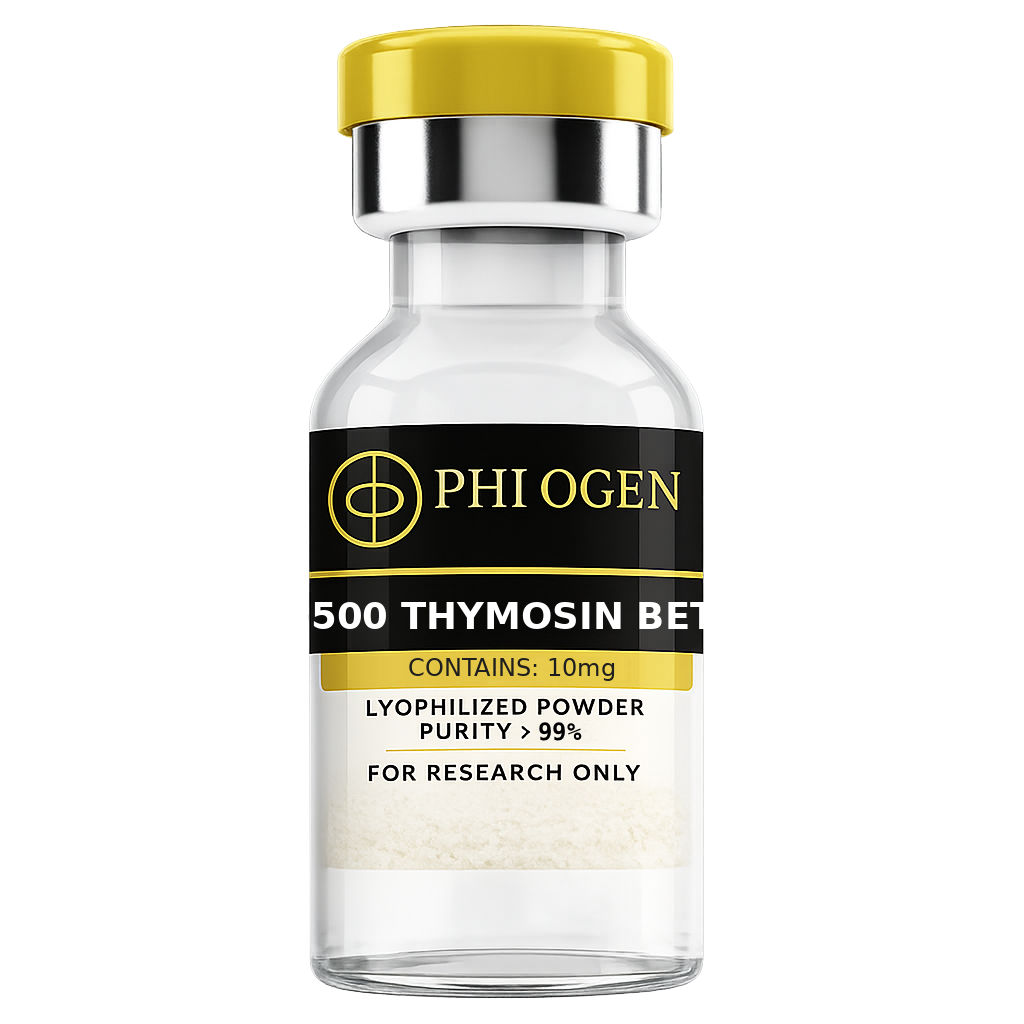
TB-500: Synthetic Thymosin Beta-4 Fragment and Bioactive Core Sequence
TB-500 is a synthetic peptide corresponding to the amino acid sequence Ac-LKKTETQ-NH2 (acetylated N-terminus, amidated C-terminus), which represents the actin-binding domain of Thymosin Beta-4 (Tβ4), the endogenous 43-amino acid polypeptide originally isolated from bovine thymus. CAS number 77591-33-4 corresponds to this heptapeptide fragment, with a molecular weight of approximately 895.05 Da for the free acid form. Tβ4 itself (CAS 77591-33-4 for the full protein applies differently depending on registry source) is encoded by the TMSB4X gene, is constitutively expressed at high concentrations in most mammalian cells, and is particularly abundant in platelets, macrophages, and wound fluid.
The identification of LKKTETQ as the minimal bioactive sequence of Tβ4 for actin interaction and wound repair activity emerged from systematic N- and C-terminal truncation studies in the 1990s. The central lysine-lysine-threonine motif is critical for G-actin binding, while the terminal residues modulate binding affinity and in vivo stability. TB-500 as a synthetic fragment was developed partly for practical reasons — producing the full 43-amino acid Tβ4 by chemical synthesis is expensive and technically challenging, whereas the 7-amino acid fragment can be produced at high purity by standard Fmoc solid-phase peptide synthesis. Critically, the heptapeptide retains the major biological activities of full-length Tβ4 in wound healing, anti-inflammatory, and angiogenic assay systems, though with somewhat lower potency per molar concentration, offset by the lower manufacturing cost enabling higher dosing.
Full-length Tβ4 is present intracellularly at concentrations of 200–500 μM in many cell types, making it one of the most abundant peptides in mammalian cells by molar concentration. Its extracellular release following cell injury or stimulation with inflammatory mediators initiates paracrine signaling that coordinates the tissue repair response.
Actin Sequestration Mechanism: G-Actin Buffering and Cell Migration
The primary biochemical function of Thymosin Beta-4 and its bioactive fragment TB-500 is the sequestration of monomeric globular actin (G-actin) — maintaining the cytoplasmic pool of unpolymerized actin available for rapid filamentous actin (F-actin) assembly. Tβ4 binds G-actin in a 1:1 stoichiometric complex with relatively high affinity (Kd approximately 0.6–1.0 μM for the full protein). This binding prevents spontaneous actin nucleation and maintains a reservoir of polymerization-competent G-actin that can be rapidly deployed to cell membranes during migration, phagocytosis, or wound closure.
The F-actin/G-actin ratio is a critical determinant of cell morphology and migratory behavior. Lamellipodia and filopodia — the leading edge structures of migrating cells — are formed by rapid localized F-actin polymerization driven by the Arp2/3 complex and formins. This polymerization consumes G-actin and would rapidly exhaust the polymerization-competent monomer pool if not continuously replenished by Tβ4-mediated buffering and cofilin-driven filament severing. Cells overexpressing Tβ4 show enhanced lamellipodia formation and migration speed in scratch wound assays, while Tβ4 knockdown cells exhibit F-actin network disruption and impaired directional migration.
In wound healing models, TB-500 application to full-thickness dermal wounds in rodents accelerates re-epithelialization by promoting keratinocyte migration. The mechanism involves TB-500 binding to integrin-linked kinase (ILK) in addition to its direct actin-buffering role, activating downstream signaling through AKT and ERK to promote actin cytoskeletal reorganization, cell polarity establishment, and directional migration toward the wound edge. This dual mechanism — actin sequestration for migration competence and receptor signaling for directional cues — positions Tβ4/TB-500 as a coordinator of the cellular migratory response.
Angiogenesis Research: Endothelial Migration, Tube Formation, and VEGF
Angiogenesis — the formation of new blood vessels from existing vasculature — is a prerequisite for wound healing, tissue repair, and recovery from ischemic injury. The process involves endothelial cell activation, basement membrane degradation, endothelial sprouting, migration, proliferation, and tube formation, followed by pericyte recruitment and vessel maturation. Thymosin Beta-4 and TB-500 have been extensively characterized as pro-angiogenic factors in multiple in vitro and in vivo model systems.
In endothelial cell (HUVEC, HDMEC) culture systems, Tβ4 and TB-500 treatment significantly increases tube formation on Matrigel, a standard in vitro angiogenesis assay. Tube length, branching, and network complexity are all enhanced at low nanomolar concentrations. The mechanism involves stimulation of endothelial cell migration through the ILK/AKT pathway, upregulation of matrix metalloproteinases (MMP-2, MMP-9) required for basement membrane remodeling, and increased VEGF-A expression through HIF-1α-dependent transcriptional mechanisms.
In ischemia models, TB-500's pro-angiogenic properties have been investigated in hindlimb ischemia (femoral artery ligation) rodent studies. Systemic TB-500 administration resulted in increased capillary density in ischemic gastrocnemius muscle (quantified by CD31 immunostaining), improved blood flow recovery (laser Doppler imaging), and preservation of limb function compared to vehicle-treated animals. Mechanistically, the improved vascularization appears to involve both endothelial sprouting from existing vessels (angiogenesis proper) and recruitment of bone marrow-derived endothelial progenitor cells (vasculogenesis). VEGF-A protein levels in ischemic tissue were significantly higher in TB-500-treated animals, suggesting amplification of the endogenous angiogenic signal.
Cardiac Research: Myocardial Infarction Models and Cardiomyocyte Survival
The heart was long considered a post-mitotic organ with negligible capacity for self-repair following myocardial infarction (MI). Tβ4 research has challenged and refined this view by identifying a population of epicardial progenitor cells (EPDCs) that can be reactivated by Tβ4 signaling to contribute to cardiac repair. This discovery, primarily from studies by Paul Riley's group at Oxford, established Tβ4 as a critical regulator of cardiac regeneration biology.
In the adult mouse heart, Tβ4 pre-treatment before left anterior descending (LAD) coronary artery ligation significantly reduced infarct size measured at 28 days by MRI, improved ejection fraction, reduced left ventricular dilation, and decreased collagen scar area in histological sections. Mechanistically, Tβ4 activates a subset of Wt1-expressing epicardial cells that undergo epithelial-to-mesenchymal transition (EMT) and migrate into the myocardium, where they can differentiate into smooth muscle cells supporting new vessel formation. Tβ4 also directly protects cardiomyocytes from ischemic apoptosis via ILK-mediated AKT activation, reducing caspase-3 activity and TUNEL positivity in the peri-infarct zone.
TB-500 studies in post-MI rodent models have demonstrated similar, if attenuated, cardioprotective effects. Intraperitoneal TB-500 administration for 4 weeks post-LAD ligation resulted in improved fractional shortening on echocardiography, reduced infarct border zone fibrosis, and increased CD31-positive capillary density compared to controls. These findings have stimulated interest in Tβ4/TB-500 as a potential therapeutic platform for promoting myocardial repair, with mechanistic questions about the relative contributions of cardiomyocyte protection, angiogenesis, and EPDC activation remaining active areas of investigation.
Neural Research: Axon Sprouting, Remyelination, and Spinal Cord Models
Central nervous system injuries — including spinal cord injury (SCI), traumatic brain injury (TBI), and ischemic stroke — present unique challenges for repair because CNS axons exhibit minimal intrinsic regenerative capacity and the post-injury environment is actively inhibitory to axon growth. Tβ4 and TB-500 have been investigated as pro-regenerative agents in several CNS injury models, with particular attention to oligodendrocyte differentiation and remyelination.
In spinal cord contusion models (weight-drop or clip compression), systemic Tβ4 treatment initiated at 24 hours post-injury improved hindlimb locomotor recovery (Basso, Beattie, Bresnahan scale) compared to vehicle controls over a 5-week observation period. Histological analysis revealed reduced lesion volume, increased preservation of white matter tracts, and increased MBP (myelin basic protein) immunostaining in peri-lesional regions, suggesting enhanced remyelination or oligodendrocyte survival. In vitro, Tβ4 promotes differentiation of oligodendrocyte precursor cells (OPCs) into mature, MBP-expressing oligodendrocytes and protects mature oligodendrocytes from TNF-α-induced apoptosis.
Axon sprouting research has examined TB-500's effects in cortical stroke models, where spontaneous axonal remodeling in peri-infarct cortex is known to contribute to functional recovery. Tβ4 treatment enhanced sprouting of corticospinal tract axons from the intact hemisphere into denervated spinal cord segments, coinciding with improved forelimb function in a skilled reaching task. The mechanism likely involves Tβ4's effects on actin dynamics at growth cone tips (promoting growth cone motility), combined with its anti-inflammatory effects that reduce the growth-inhibitory environment. These neural repair findings position TB-500 as a subject of considerable interest in CNS injury research.
Anti-Inflammatory Mechanisms: Cytokine Modulation and NF-κB Pathway
Inflammation is a necessary but carefully regulated component of tissue repair. Excessive or prolonged inflammatory signaling converts acute repair into chronic fibrotic pathology. Tβ4 and TB-500 have dose-dependent anti-inflammatory effects demonstrated across multiple in vitro and in vivo systems, contributing to their broad tissue repair profile.
At the cellular level, Tβ4 inhibits NF-κB activation in macrophages and endothelial cells challenged with LPS or IL-1β. The mechanism involves inhibition of IκB kinase (IKK) complex activation, preserving IκBα from phosphorylation and subsequent proteasomal degradation. Intact IκBα sequesters the p65/p50 NF-κB heterodimer in the cytoplasm, preventing transcription of pro-inflammatory target genes including IL-1β, IL-6, TNF-α, COX-2, and iNOS. In LPS-challenged macrophages, Tβ4 pre-treatment reduced TNF-α secretion by approximately 60% and IL-6 by approximately 50% at concentrations of 10–100 ng/mL.
In vivo, TB-500 demonstrated anti-inflammatory effects in carrageenan-induced paw edema models (a standard acute inflammation assay) with potency comparable to low-dose NSAIDs but without the cyclooxygenase mechanism. In colitis models, Tβ4 treatment reduced colonic inflammatory infiltrate, decreased myeloperoxidase (MPO) activity (a neutrophil marker), and preserved intestinal barrier integrity as measured by tight junction protein (ZO-1, claudin-1) expression. The combined anti-inflammatory and pro-repair profile of TB-500 — reducing harmful inflammatory signaling while promoting angiogenesis and cell migration — positions it as a multifunctional tissue repair research agent rather than a purely anti-inflammatory or purely repair-promoting compound.
Multi-Tissue Research Overview: Muscle, Tendon, Cornea, and Hair Follicle
One of the remarkable features of Tβ4/TB-500 biology is the breadth of tissue systems in which it has demonstrated research activity. This reflects the ubiquitous expression of the actin cytoskeleton as a target and the broad distribution of ILK, the signaling receptor for Tβ4, across tissue types.
In skeletal muscle, Tβ4 accelerates repair following BaCl2-induced muscle injury in mice. Immunofluorescence studies show increased Pax7-positive satellite cells at 3 days and increased MyoD and Myogenin expression at 5 days post-injury, with histological evidence of accelerated fiber regeneration (smaller centrally nucleated fibers with fewer inflammatory infiltrates) compared to vehicle-treated mice at 14 days. In tendon research, Tβ4 application to partially transected Achilles tendons in rats increased collagen fibril density (transmission electron microscopy) and improved mechanical properties (failure load, stiffness) at 6-week endpoints. In corneal injury models (alkali burn or epithelial scrape), topical Tβ4 application accelerated re-epithelialization and reduced corneal haze, consistent with its pro-migratory effects on corneal epithelial cells.
Hair follicle research represents an unexpected application area. Tβ4 is expressed in the hair follicle stem cell niche and is required for normal stem cell activation at the onset of anagen (hair growth phase). Tβ4-null mice exhibit delays in anagen initiation and reduced hair growth rate. Topical Tβ4 application in normal mice accelerated anagen onset after depilation-induced synchronization of the hair cycle, findings that have prompted investigation of Tβ4 analogs for hair loss research.
Peptide Chemistry, Stability, and Research Protocol Considerations
TB-500 as a synthetic heptapeptide (Ac-LKKTETQ-NH2) is produced by standard Fmoc solid-phase peptide synthesis (SPPS) with purity typically verified by reverse-phase HPLC (>98% purity standard for research grade) and identity confirmed by mass spectrometry (ESI-MS or MALDI-TOF). The molecular formula for the free acid form is C33H57N11O14, molecular weight approximately 895.05 Da (the exact value varies slightly between sources due to salt form differences and whether N-terminal acetylation and C-terminal amidation are included in the calculation).
Lyophilized TB-500 is stable at -20°C for extended periods when protected from moisture and light. Reconstitution is typically performed with bacteriostatic water (0.9% benzyl alcohol) or sterile water for injection. The peptide is highly soluble at physiological pH and does not require acidic or basic reconstitution conditions, unlike some larger or more hydrophobic peptides. Once reconstituted, TB-500 solutions should be stored at 4°C and used within 2–4 weeks, with freeze-thaw cycles minimized to prevent aggregation of the reconstituted peptide.
In rodent research protocols, TB-500 is most commonly administered by subcutaneous or intraperitoneal injection. Effective doses in published studies range from 2 mg/kg to 30 mg/kg depending on the model, injury severity, and endpoint. The relatively small molecular weight (895 Da) allows subcutaneous bioavailability exceeding 80% in rodents (estimated from radiolabeled peptide studies with related Tβ4 fragments), making subcutaneous administration a practical alternative to IP injection for chronic dosing experiments.